Custom website vs. WordPress: the difference that affects your SEO and brand
The market is over-saturated with WordPress sites sold as “easy to edit”. In reality you risk performance, SEO, and stability. From experience, here is when a custom website with a CMS is the right call — and why your site is really your business's résumé.
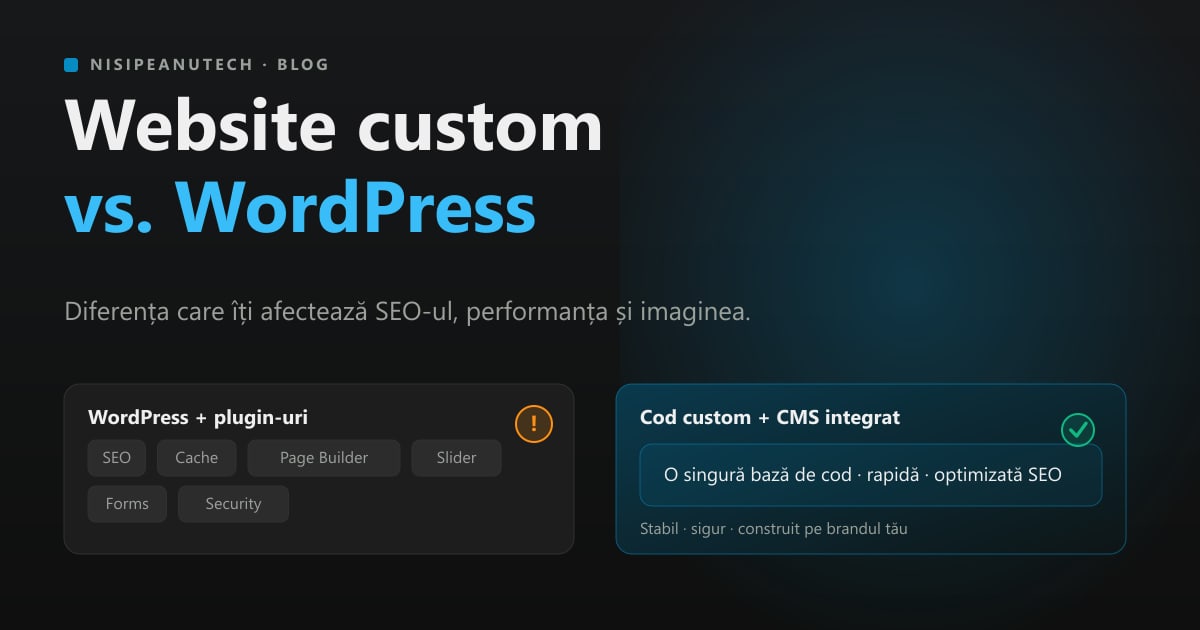
The Romanian web development market is over-saturated with WordPress sites. They are everywhere, and the sales pitch is almost always the same: “you can edit it easily, no developer needed”. It sounds great on paper. In practice, you usually pay for that “ease” with your site's performance, SEO, and stability.
I've built and shipped projects in both worlds, and I have the same conversation with nearly every new client. That's why I wrote this article: so you can clearly see the difference between a custom website and a WordPress website, and understand when each one is worth it — no marketing, just real experience.
WordPress vs. custom website: what we're actually talking about
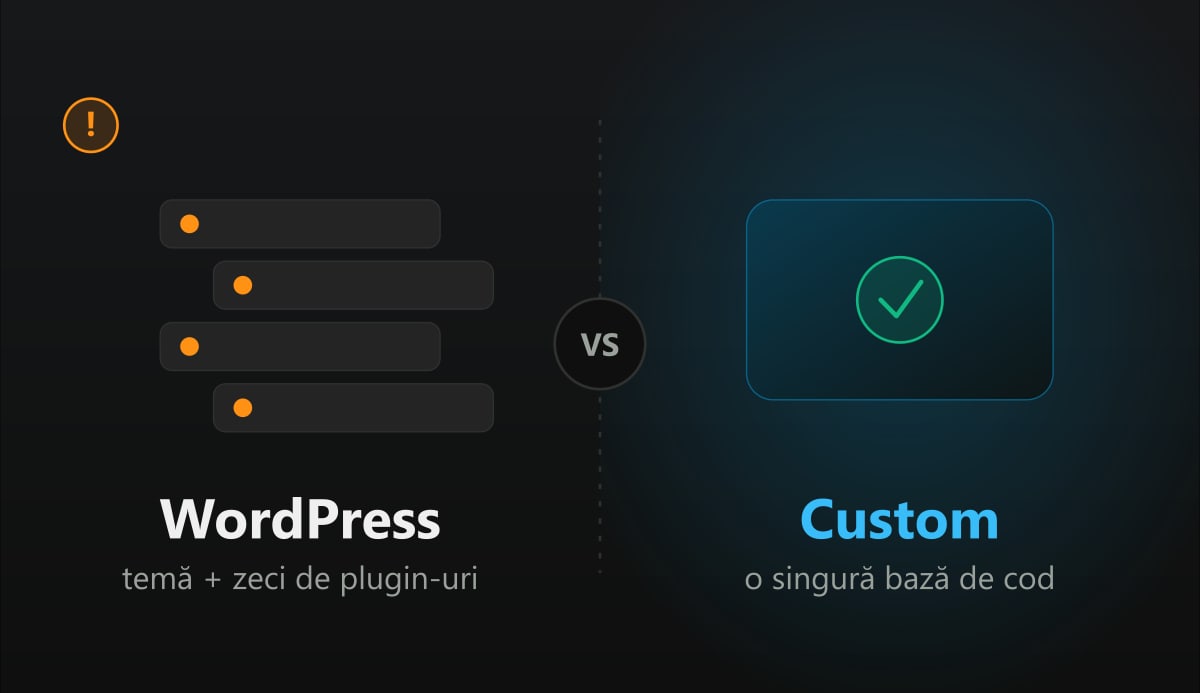
A WordPress website is essentially a generic CMS on top of which you add a theme (a template) and a stack of plugins for every feature you need: SEO, forms, cache, security, page builder, slider and so on. Each piece is made by someone else, for millions of different sites — not for yours.
A custom website is built in code, exactly around your needs, with an integrated CMS that lets you edit content just as easily — but without the useless layers. Even the blog you're reading now is exactly this kind of system: stable code, a visual editor behind it, optimized from day one.
The “easier to edit” myth
The most common reason someone picks WordPress is editing. The reality is that “easy to edit” quickly becomes “hard to maintain”. To get a site that looks good, you add a page builder (Elementor, WPBakery), then five more plugins to make up for what the theme doesn't do, and you end up with a conglomeration of components fighting each other.
Many people think they're avoiding a developer. In practice, most end up paying a “WordPress specialist” to configure the theme, fix plugin conflicts, and get the site on its feet. You paid for independence and got a dependency instead — just on a template, not on a product that's truly yours.
SEO and performance: where WordPress loses
This is where the difference shows most clearly. Every plugin adds extra CSS, JavaScript, and database queries. A simple presentation site ends up loading dozens of files it doesn't need, and Google measures exactly that through Core Web Vitals: loading speed, visual stability, and interactivity.
In a custom website you control every kilobyte: you ship only the necessary code, structure the markup correctly, and handle images and caching exactly as they should be. The result is high PageSpeed scores, clean indexing, and a technical foundation you can build a real SEO strategy on — not one limited by what the theme allows.
In short: with WordPress, technical SEO is a constant fight against your own platform. With a custom site, it's an architecture decision you make once, correctly.
Stability, security, and maintenance
WordPress is the most attacked platform in the world, precisely because it's the most widespread. Most breaches don't come from the WordPress core, but from outdated third-party plugins. Every update becomes a little roulette: a plugin update can break your layout or take the site down.
A custom site has a much smaller attack surface and predictable behavior: there aren't dozens of extensions written by strangers running on your server. Maintenance becomes planned, not an emergency reaction to the next problematic update.
When WordPress does make sense
To be fair: WordPress isn't “bad” in itself, and there are situations where it's the right choice. If you want to start on your own, with no budget and no technical knowledge, a personal blog or a very simple WordPress site can get you going quickly.
The problem appears when a serious business treats WordPress as a “professional” solution, yet still ends up paying a developer for the template, premium plugins, and repairs. At that point, a custom presentation website costs comparable and delivers far more — and long term, it usually costs less.
Your website is your business's résumé
A good website has to express the idea of the company behind it. It's one with your image: a website is essentially an entrepreneur's résumé and the face of the business. If your image looks exactly like every other site on the internet — same template, same sections, same structure — how do you stand out?

This is a conversation I have with all my clients: we don't build a site just so you can tick the box of “having a site”, but so it conveys exactly what you stand for and why you're different.
A custom site gives you full control over design, voice, and visitor experience. You're not limited by what a theme author decided for millions of users — you start from your brand and build around it.
Head-to-head comparison
| Criteria | Custom website | WordPress |
|---|---|---|
| Performance & Core Web Vitals | Optimized in code, only what's needed | Weighed down by theme and plugins |
| Technical SEO | Full control over speed, markup, structure | Depends on plugins and the theme |
| Stability | A single, tested code base | Updates that can break the site |
| Security | Small attack surface | Plugins = frequent vulnerabilities |
| Content editing | Integrated CMS, clean and simple | Simple at first, chaotic over time |
| Customization & identity | 100% on your brand | Limited by the template |
| Cost over time | Predictable | Grows with maintenance and repairs |
How we deliver a custom site that's still easy to edit
The biggest fear about “custom” is getting stuck: not being able to change a line of text without a developer. We solve exactly that. We build the site in code (Next.js, React), but with an integrated CMS and a visual editor, just like this blog — you add articles, edit pages, and change content yourself, without touching the code.
That gives you the best of both worlds: the stability, speed, and SEO of a custom site, plus the editing ease WordPress promised you. You can see real results in our portfolio or explore the custom platforms we build.
Conclusion
In 9 out of 10 cases, for a business that takes its online presence seriously, WordPress gets in the way more than it helps. A custom website with a CMS gives you stability, SEO, security and — most importantly — an image that's yours, not one borrowed from a template.
If you want a site that truly represents you, let's talk about your project. I'll tell you honestly which approach makes sense for your situation — even when it isn't the most expensive one.
Frequently asked questions
Is a custom site more expensive than a WordPress one?
At first glance it can seem so, but the total cost of a “proper” WordPress site (premium theme, plugins, a developer for setup and repairs) often ends up similar. Long term, a well-built custom site usually costs less in maintenance.
Will I be able to edit the content myself?
Yes. We deliver an integrated CMS with a visual editor, exactly like the system behind this blog. You edit text, images, and pages without technical knowledge.
Can an existing WordPress site be migrated to a custom solution?
Yes. We keep the content and the SEO-important URLs, then rebuild the site on a fast, stable technical foundation, with proper redirects so you don't lose rankings in Google.
Want a website that truly represents you?
Tell us briefly about your business and get an honest recommendation: which approach makes sense, at what budget, and what results to expect.